


The Truth Layer: Rewriting the Economics of Tenant Oversight
Navigating the commercial property market with confidence is a notorious challenge for corporate tenants. The advisory landscape is largely unregulated, creating an environment filled with ambiguity where occupiers are forced to operate at a structural disadvantage, and at great expense.
The core of the issue is a fundamental misalignment of interests. A landlord’s sole driver is to maximise yields and extract as much revenue as possible from an asset. Property and asset managers aren't merely overstretched; they are entirely at the mercy of these paymasters. Because their primary financial accountability is to the landlord, they are structurally incentivised to find ways to recover and protect money for them, not to look out for the tenant's bottom line.
This leaves the occupier caught in a system engineered to maximise their outgoings while offering very little visibility or flexibility in return.
Upfront Transparency: A New Foundation of Trust
When we first conceptualised Leamur, we knew we had to separate ourselves entirely from the traditional reputation of the property industry. Having seen how badly tenants have been let down by the status quo historically, our goal is to act as the ultimate truth layer and a genuinely trusted partner for occupiers.
For us, that commitment to absolute clarity and control starts by rewriting how technology vendors operate in this space, beginning with the economics. Leamur is the only AI-powered, in-house real estate expert built on a foundation of upfront, benchmarked pricing transparency.
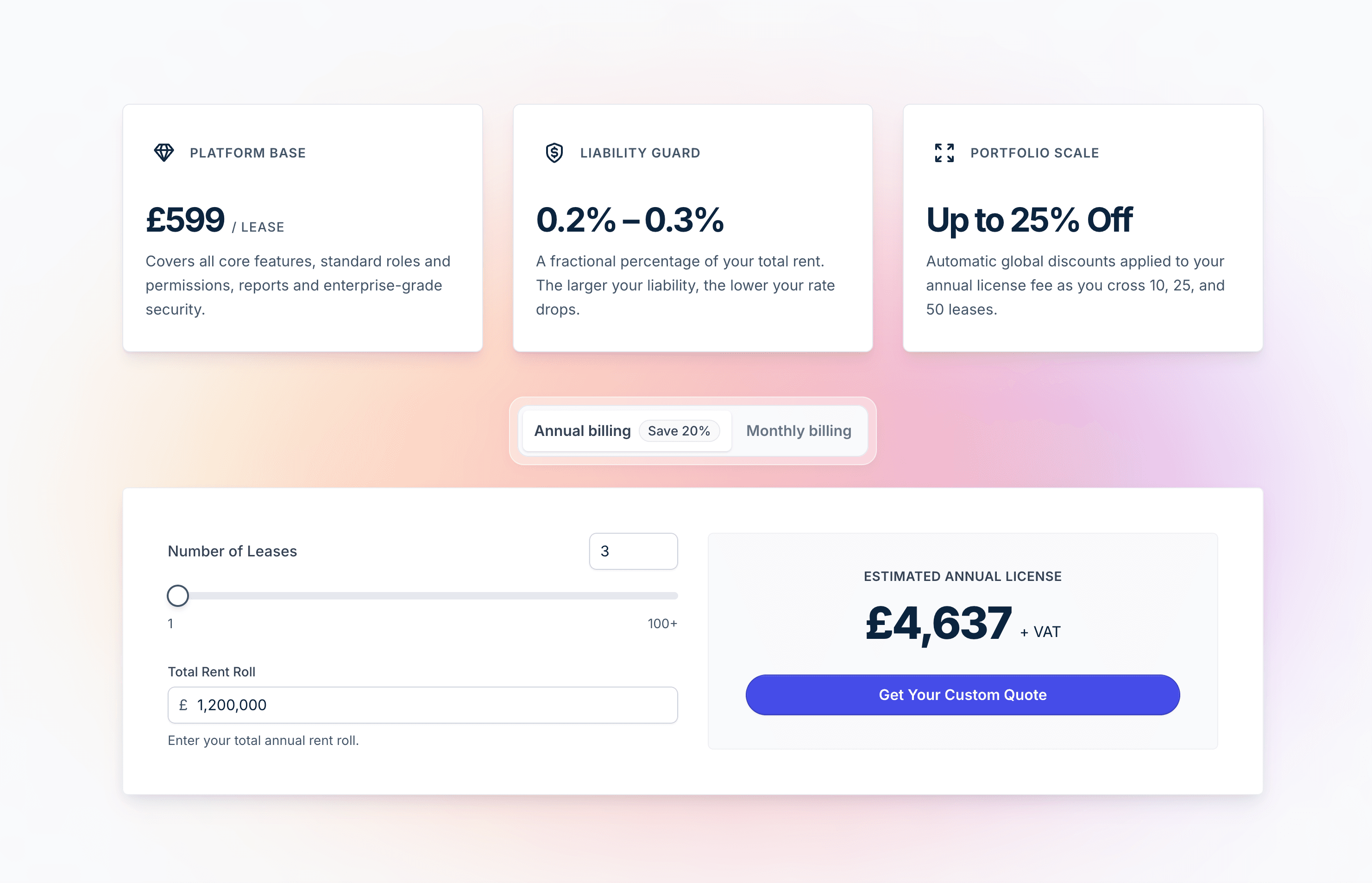
While we structure tailored enterprise tiers for large-scale operations and accommodate add-ons for bespoke technical integrations, our underlying commercial model is entirely predictable. It scales cleanly based on the quantum of the liability, applying compounding discounts for higher individual rent rolls or larger overall portfolios.
To make this as friction-free as possible, our pricing calculator is available directly on our website. You can map out your exact costs instantly; with no sign-up gates, no drawn-out RFP processes, and no requirement to share sensitive company information. Pricing starts from just £50.00 per month and typically amounts to a small fraction of a percent of total real estate outgoings.
In the context of the overheads it monitors, it is a highly accessible baseline, especially when measured against the potential returns. Leamur targets a >10x return on investment and is currently delivering a rolling 24x ROI.
Crucially, we calculate this number strictly on executed, direct financial savings alone, meaning hard currency actually recovered or carved out of bills and leases. We don't inflate the value by including potential savings achieved through optimisation or risk identification, even though those functions are fundamental to the platform.
The Complexity Trap: Why Manual Tracking Fails
Inside some businesses, there is a secondary challenge: the belief that these complex property obligations can be fully and successfully managed purely through manual human oversight.
The reality is that properly managing commercial premises is simply far too broad, specialised, and complex for individual personnel to cover everything, all the time. While designated in-house teams or corporate solutions arrangements materially move the needle, true visibility and control requires constant review of external, highly dynamic variables, encompassing legal, geo-spatial, physical, lease-specific, market, and commercial factors.
All of these factors impact dozens of different real estate liabilities and considerations which are so sophisticated that they have whole advisory industries built around them. To ask a single person or fragmented team to synthesise them all in real time is an impossible ask.
Unifying the Puzzle: From Fragmented Teams to Absolute Control
This issue becomes even worse when responsibilities don't sit with a dedicated real estate team, but are instead split across different operational functions. When tasks are divided between departments like finance, legal, and operations, premises management inevitably conflicts with their other core priorities. Because these teams don't necessarily talk to each other often, no one has oversight of the whole puzzle.
When property management is treated as a secondary administrative task handled in pieces, oversights are built directly into the architecture. It is a data infrastructure problem, not a people problem.
By unifying financial, legal, and operational data into a single automated engine, Leamur provides the definitive truth layer tenants need to neutralise landlord asymmetry. But true control can only be built on absolute trust. That is why our platform and our business operate on the exact same principle: total visibility. We don’t just clear up the confusion hidden within your leases; we eliminate the ambiguity of the property industry itself; and that commitment to absolute transparency starts upfront, the moment you look at our pricing.