

Deterministic vs Probabilistic AI: Why Guessing Will Ruin Your Compliance
The biggest mistake enterprise leaders make with artificial intelligence is treating all models as if they do the same job. They do not.
Right now, companies are rushing to integrate AI into every department. They see a chatbot write a brilliant marketing email in three seconds and assume that same underlying technology can review a 50 page commercial lease or audit their health and safety compliance.
That assumption is the single largest hidden liability in corporate tech today. To understand why, you have to understand the difference between probabilistic and deterministic systems.
The Probabilistic Trap
Almost all the popular AI tools on the market today are probabilistic. At their core, Large Language Models are incredibly advanced prediction engines. They do not actually "know" facts. They simply calculate the most probable next word based on their training data.
In creative or generative tasks, this probability is a feature. If you need ten ideas for a new product launch, you want the AI to be creative and make intuitive leaps.
But in enterprise compliance and commercial property management, creativity is a catastrophe.
If you ask a generic AI wrapper to extract the exact rent review date or the break clause conditions from a scanned commercial lease, you do not want a probable guess. You want the absolute truth. If a probabilistic model cannot clearly read a poorly scanned paragraph, it might hallucinate a date that looks plausible.
In the real world, missing a break clause by a single day because of a hallucinated date does not just cause a minor operational hiccup. It locks your company into another five year lease and costs hundreds of thousands of pounds.
The Deterministic Requirement
High stakes operations require a completely different architectural approach. They require deterministic intelligence.
A deterministic system is grounded in absolute rules and factual data. It does not guess. It is engineered so that a specific input will always produce the exact same reliable output. If the information is missing from the document, a deterministic system will flag the missing data rather than inventing a plausible sounding lie.
When it comes to corporate liability and real estate compliance, executive boards need guarantees. They need a system that reads complex legal language and maps it directly to strict business logic.
How We Engineered the Difference
When we built the engine behind Leamur, we knew we could never rely on probability for tenant compliance. Our users are dealing with massive financial targets and strict local council regulations.
We use AI for what it does best, which is reading and structuring messy, unstructured inputs like scanned PDFs and legacy contracts. But the moment that data is extracted, it enters a deterministic pipeline.
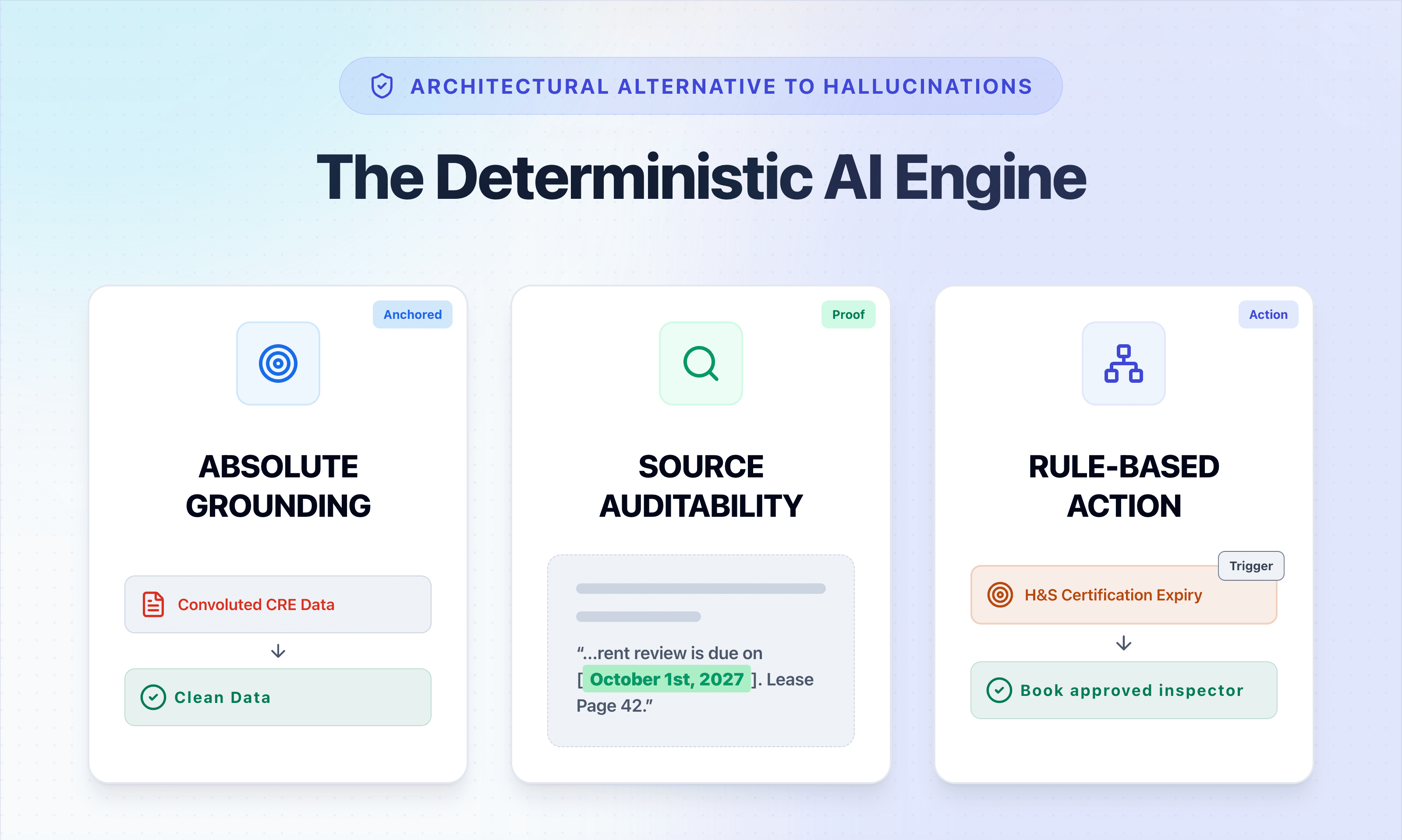
Our architecture enforces three strict rules to eliminate hallucinations:
- Absolute Grounding: Every compliance date, financial figure, and legal obligation is cross referenced against the raw document.
- Source Auditability: When the system alerts a CFO to a hidden cost saving, it does not just provide a summary. It provides direct, verifiable links to the exact source material.
- Rule Based Action: We map the extracted data against thousands of verified external inputs. If a health and safety certificate expires in 30 days, the system triggers a deterministic workflow to notify the operations team of exactly what needs to be done, by when and how. No guesswork involved.
Stop Buying Probability for Deterministic Problems
The AI hype cycle has convinced businesses that a smart chatbot can solve every problem. But enterprise leaders must look under the hood.
Using a probabilistic model to manage something like legal compliance is the equivalent of asking a creative novelist to do your corporate tax returns. The output might read beautifully, but it will not hold up in court.
If you want to protect your balance sheet and keep your directors out of liability traps, you must demand deterministic architecture. If your AI vendor cannot explain exactly how they prevent hallucinations and guarantee auditability, they are not ready for the enterprise.